Downtime Is Not a Maintenance Problem. It Is a Financial Emergency.
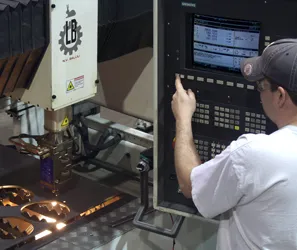
Photo: Mercurybds, CC BY 3.0, via Wikimedia Commons
When a laser system fails unexpectedly on a Tuesday morning, the first call goes to maintenance. The second call goes to the vendor's service line. The third call — the one that determines how serious the situation really is — goes to the production scheduler, who now has to figure out what to do about the orders that were supposed to ship by Friday.
It is that third call, and everything that follows from it, that represents the true cost of laser system downtime. The repair bill is visible, documented, and finite. The cascading financial consequences that unfold across the next three to ten business days are diffuse, difficult to attribute, and almost never captured in any single cost report. For many US manufacturers, this accounting gap means that the real financial exposure of unplanned outages is substantially underestimated — sometimes by an order of magnitude.
Building the Real Cost Model
A rigorous assessment of downtime cost requires accounting for five distinct cost categories, each of which operates independently and compounds in relation to the others.
Direct repair costs are the starting point. Parts, labor, and — where applicable — field service travel expenses from the equipment supplier. For a mid-range industrial fiber laser system, a significant mechanical or optical failure can generate repair costs ranging from $8,000 to $45,000 depending on the nature of the failure and the availability of components. These costs are real, but they are also the most manageable element of the equation.
Production delay costs are where the numbers begin to escalate. A laser system running two production shifts is generating output at a rate that can be calculated with reasonable precision. When that output stops, the cost is not simply the margin on the parts that were not made. It includes the fixed overhead — labor, facility, utilities — that continues to accrue while the machine sits idle. For a facility running a laser system at full utilization, a five-day outage can represent $60,000 to $120,000 in unrecovered fixed costs alone, before any revenue impact is considered.
Rush logistics and outsourcing premiums are the next layer. When a manufacturer cannot fulfill an order on schedule, the choices are limited: outsource the work at spot-market rates, expedite shipping on whatever can be produced through alternative means, or negotiate a delivery extension with the customer. All three options carry direct financial penalties. Contract manufacturers charging rush rates typically apply premiums of 25 to 40 percent above standard pricing. Expedited freight on heavy industrial components can cost three to five times standard shipping rates. Neither of these costs appears in the maintenance budget.
Quality rework from process interruption is a less obvious but significant contributor. When a laser process is interrupted mid-run and restarted under different thermal conditions, the first several parts of the resumed production run frequently fall outside specification. In precision applications, this can mean scrapping work-in-progress that already has substantial material and labor value embedded in it. Across a facility running multiple part families simultaneously, the rework exposure from a single significant outage can reach tens of thousands of dollars.
Opportunity cost and contract risk represent the largest and most difficult-to-quantify category. A manufacturer that misses a committed delivery date faces consequences that extend well beyond the immediate order. Repeat business is jeopardized. In industries where supplier scorecards determine future contract allocation — automotive, aerospace, and defense supply chains, for instance — a single documented delivery failure can affect contract awards for years. The financial value of that lost opportunity is real, but it will never appear on a maintenance cost report.
The $2 Million Threshold
Aggregate these five cost categories across a realistic production environment — a US manufacturer running two or three laser systems at high utilization, serving customers with defined delivery commitments — and the total annual exposure from unplanned downtime events can approach or exceed $2 million when opportunity costs are included. This figure is not theoretical. It reflects the cumulative impact of two or three significant unplanned outages per year, which is consistent with what maintenance records show for laser systems operating without structured preventive programs.
The critical insight is that this $2 million exposure does not require a catastrophic failure. It accumulates through a series of individually manageable-seeming events: a three-day outage here, a partial-shift interruption there, a quality excursion that requires a week of rework. Each event, viewed in isolation, appears to be a contained maintenance issue. Viewed in aggregate, they represent a structural drain on operational profitability.
What Preventive Investment Actually Costs — and Returns
A well-designed preventive maintenance program for an industrial laser system typically costs between $15,000 and $35,000 per year per machine, including scheduled service visits, consumable replacement on a defined cycle, optics inspection, cooling system maintenance, and real-time diagnostic monitoring subscriptions where available. For a three-machine facility, total annual preventive investment might reach $75,000 to $90,000.
Against a downtime exposure of $2 million, that investment represents a risk-reduction ratio that most CFOs would find straightforward to justify — if the full cost model were ever presented to them in those terms. The challenge is that it typically is not. Maintenance budgets are reviewed in isolation from production loss accounting, logistics premiums, and contract risk assessments. The preventive investment looks like a cost. The downtime exposure it prevents looks like a series of unfortunate operational events.
Changing that framing is a financial management challenge as much as a technical one.
Metrics That Justify the Investment
For plant managers and operations directors seeking to make the case for increased preventive maintenance investment, three metrics provide the most compelling foundation.
Mean Time Between Failures (MTBF) establishes the baseline against which preventive program effectiveness can be measured. Facilities that do not currently track MTBF by machine should begin doing so immediately — it is the foundational data point for any credible downtime cost analysis.
Downtime Cost Per Hour should be calculated for each laser system, incorporating all five cost categories described above. This number, presented to finance leadership, reframes maintenance investment as insurance rather than overhead.
Preventive-to-Reactive Maintenance Ratio measures whether the facility's maintenance posture is genuinely proactive or merely reactive with a scheduled component. A ratio below 60 percent preventive is a warning sign that unplanned outage exposure remains high.
The Strategic Imperative
For US manufacturers operating in competitive markets with demanding delivery commitments, laser system reliability is not a maintenance department concern. It is a strategic business asset. The facilities that recognize this — and invest accordingly in preventive programs, real-time diagnostics, and structured service agreements — are not spending more on maintenance. They are spending less on emergencies, and the difference is substantial.