Diagnostic Blindness: How Laser Systems Are Collecting the Answers Your Technicians Can't Find

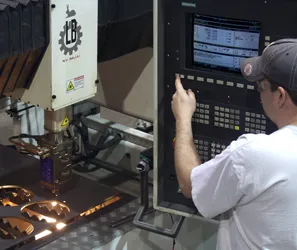
Photo: industrial laser technician reviewing diagnostic data on computer screen in manufacturing facility, via assets.adidas.com
There is a particular frustration familiar to any production manager who has watched a skilled technician spend three hours chasing a cutting anomaly — adjusting focus, cleaning optics, cycling power — only to find the answer buried in a performance log the system had been maintaining quietly for weeks. The data was there. The problem was documented. No one had looked.
This is not a failure of competence. It is a failure of process, and it is far more common across American manufacturing floors than most operations leaders care to acknowledge.
The Intelligence Gap No One Talks About
Contemporary fiber laser platforms are, in a meaningful sense, self-documenting machines. They record power output fluctuations, thermal load cycles, beam path alignment shifts, assist gas pressure deviations, and dozens of additional parameters — often at intervals measured in milliseconds. A mid-range industrial laser system operating a standard two-shift schedule can accumulate more diagnostic data in a single week than a technician could meaningfully review in a month.
Yet the dominant troubleshooting culture in most facilities remains largely tactile and observational. Technicians listen for irregular sounds. They examine cut edges for burring or incomplete kerf. They check consumable wear by hand. These methods are not without value — experienced operators develop genuine pattern recognition that no software dashboard fully replicates. The problem arises when intuition-first diagnosis becomes the default approach even when structured data is readily available and more reliable.
The result is a paradox: your most experienced technician may be the least likely person to consult the system logs, precisely because experience has taught them that they can usually find the answer without doing so. Until they cannot.
Why Technicians Don't Use the Data They Have
Understanding this gap requires looking at how diagnostic access is structured — or more accurately, how it typically is not structured — within manufacturing operations.
In many facilities, performance logs are accessible only through proprietary software interfaces that were configured during installation and rarely revisited. Some systems require separate login credentials that were assigned to a maintenance supervisor who left the company two years ago. Others export data in formats that require interpretation software the facility never licensed. A significant number of operators simply do not know the logs exist in a form they can query.
Even where access is technically available, there is often no established protocol for when or how to use it. Troubleshooting workflows are passed down through institutional knowledge — from senior technician to apprentice — and those workflows were developed during an era when laser systems were less instrumented. The habits predate the data.
There is also a subtler barrier: the sheer volume of logged information can feel paralyzing rather than useful. A technician confronting hundreds of columns of timestamped output values, with no guidance on which thresholds are meaningful or how to correlate separate data streams, may reasonably conclude that their instinct is a more efficient diagnostic tool. In the short term, they are often right. Over time, this approach accumulates risk.
What Hides in the Logs
The categories of problems most likely to escape intuition-based diagnosis share a common characteristic: they are gradual, nonlinear, and invisible until they cross a threshold.
Power output drift is a representative example. A laser resonator losing efficiency over a period of weeks may still produce visually acceptable cuts for most of that period, because operators unconsciously compensate — adjusting feed rates, tweaking focal position — without recognizing that they are masking a systemic decline. The performance log, however, will show a clear trend line. A technician reviewing that data could identify the deterioration weeks before it manifests as a production defect or an unplanned downtime event.
Similar patterns appear in thermal management data. Cooling system performance that is degrading gradually will register in temperature differential logs long before it produces the kind of obvious symptom — overheating shutdowns, visible beam instability — that triggers an urgent response. The same is true of assist gas delivery inconsistencies, beam path contamination accumulation, and motion system compliance changes.
In each case, the information exists. The question is whether the organization has built a pathway for that information to reach the person who can act on it.
Building a Framework for Data-Informed Troubleshooting
Closing this gap does not require replacing experienced technicians with data analysts. It requires building a structured interface between the two modes of knowledge — empirical observation and logged performance history — so that each informs the other.
The first step is access normalization. Every technician who is authorized to troubleshoot a laser system should have direct, credentialed access to that system's performance logs, without requiring supervisor intermediation. This sounds basic, but a surprising number of facilities have never formally established it.
The second step is threshold documentation. Work with your equipment supplier — or, if your supplier does not offer this service, with an independent laser systems specialist — to identify the specific logged parameters that are most diagnostically meaningful for your machine configuration and application. Define the ranges that represent normal operation and the deviations that warrant investigation. Post these thresholds where technicians can reference them during troubleshooting, not buried in a manual.
The third step is protocol integration. Incorporate a log review requirement into your standard troubleshooting workflow. Before a technician makes any hardware adjustment in response to a quality deviation, require a five-minute log review covering the preceding 24 to 48 hours. This does not replace hands-on diagnosis — it precedes it, and it often makes the hands-on work significantly faster and more targeted.
Finally, consider periodic trend reviews as a scheduled maintenance activity rather than a reactive one. A monthly review of key performance metrics — even a 30-minute session — can surface developing issues weeks before they become urgent. The investment is minimal. The return, measured in avoided downtime and extended component life, is substantial.
The Organizational Dimension
It is worth stating plainly that the barriers described here are not primarily technical. The data infrastructure already exists in most modern laser platforms. The challenge is organizational: building the habits, the protocols, and the access structures that allow diagnostic intelligence to flow from the machine to the people responsible for its performance.
Manufacturers who treat their laser systems as passive production tools — running them until something breaks, then calling for service — will continue to leave performance and reliability on the table. Those who treat the diagnostic data their systems generate as a continuous operational resource will find that their best technicians become significantly more effective, not despite their experience, but because that experience is now informed by evidence they previously had no reason to consult.
The system already knows what is wrong. The question is whether your organization is structured to listen.