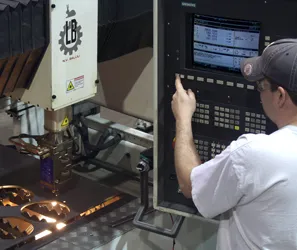
The New Operator: How a Generation of Data-Native Engineers Is Redefining Laser System Management

Photo: young engineer tablet monitoring industrial laser system data analytics, via en-images.kinorium.com
Walk into a laser cutting facility staffed primarily by operators who have been in the trade for twenty or more years, and you will observe a particular kind of competence. An experienced hand adjusts assist gas pressure based on the sound the cut is making. A veteran technician diagnoses a beam alignment issue by examining the kerf geometry on a test piece. These are genuine skills — hard-won, reliable, and deserving of respect. They are also, in certain important respects, becoming insufficient for the demands of modern manufacturing.
Now walk into a facility where the lead laser engineers are in their late twenties or early thirties, trained in mechatronics or industrial engineering programs that integrated data systems and software platforms as core curriculum. The contrast is instructive. These operators are not better at reading a cut by ear. They may not have the tactile familiarity with machine behavior that comes from years of direct experience. But they are doing something their predecessors are not: they are treating the laser system as a data-generating asset, and they are using that data to make decisions that compound over time.
A Different Relationship With the Machine
The distinction between these two operator profiles is not simply a matter of generational preference for technology. It reflects a fundamentally different mental model of what a laser system is and how it should be managed.
For the veteran operator, the machine is a physical instrument whose behavior is understood through direct sensory engagement. Experience builds a library of patterns — sounds, smells, visual cues — that enables rapid diagnosis and adjustment. This model works well when conditions are stable and familiar. It struggles when the failure mode is gradual, when the degradation is occurring in a subsystem the operator cannot directly observe, or when the relevant signal is buried in data that no human sensory system can process in real time.
For the data-native engineer, the machine is a node in an information network. Its sensors are not merely safety interlocks — they are continuous sources of operational intelligence. The laser's power output history, the chiller's temperature variance trend, the resonator's pulse stability over the last 500 operating hours: these are not technical details to be reviewed when something goes wrong. They are inputs to an ongoing optimization process that runs in parallel with production.
This is not a philosophical distinction. It has measurable operational consequences.
What the Data Shows — When Someone Is Looking
Modern industrial laser systems, including the fiber and CO2 platforms that dominate US manufacturing facilities, generate substantial diagnostic data as a matter of course. Laser power monitors, beam profiling systems, thermal sensors, and motion system encoders all produce continuous data streams that are, in most facilities, either logged and ignored or not reviewed until a failure event prompts a retrospective analysis.
The data-native engineer approaches this differently. Rather than treating diagnostic data as a post-failure resource, they establish baseline performance profiles for each system and configure alerts for statistically significant deviations. A chiller temperature that trends 1.5 degrees above its historical baseline over a two-week period is not an alarm condition. It is a leading indicator — one that an experienced operator might not notice until it manifests as a beam quality problem, but that a data-oriented engineer can act on weeks earlier.
The practical impact of this approach is most visible in maintenance outcomes. Facilities where younger engineers have implemented structured monitoring programs consistently report reductions in unplanned downtime, not because the machines are inherently more reliable, but because degradation is being identified and addressed before it reaches failure threshold. The machine has not changed. The way it is being observed has.
The Training Gap — and Who Is Responsible for Closing It
The shift toward data-driven laser operation creates a training challenge that the US manufacturing sector has been slow to address formally. Apprenticeship and on-the-job training models, which remain the dominant pathway into laser operation for many facilities, transfer experiential knowledge effectively but do not naturally incorporate data literacy, software integration skills, or predictive analytics methodology.
At the same time, engineering graduates entering manufacturing facilities bring strong data and software capabilities but often lack the physical intuition and process knowledge that experienced operators possess. The result is a competency gap that runs in both directions: veteran operators who are underutilizing the diagnostic capabilities of their equipment, and young engineers who are technically sophisticated but process-naive.
Closing this gap requires deliberate program design. The most effective training structures pair experienced operators with data-oriented engineers in a structured knowledge exchange — not simply mentorship in the traditional sense, but a formal process in which experiential knowledge is translated into documented process parameters, and data literacy is applied to validating and refining those parameters over time. The veteran's intuition becomes a hypothesis. The young engineer's data tools become the validation mechanism. Together, they produce something neither could generate independently.
Vendor Relationships Are Changing Too
The rise of data-native operators is also reshaping how US manufacturers engage with laser system vendors. The purchasing conversation has shifted in meaningful ways. Where previous generations of buyers prioritized specifications — peak power, positioning speed, cutting envelope — today's technically sophisticated buyers are asking increasingly detailed questions about software architecture, API accessibility, data export formats, and integration compatibility with existing MES and ERP platforms.
This matters for vendor selection in ways that extend beyond the initial purchase. A laser system that cannot expose its operational data to external analysis tools is, from the perspective of a data-native engineering team, a closed system — capable of performing its primary function but unable to participate in the broader operational intelligence infrastructure the facility is building. For manufacturers who have invested in IoT monitoring platforms, cloud-based analytics, or predictive maintenance software, a laser system that cannot communicate with those platforms represents a gap in the data ecosystem.
Vendors who understand this — and who design their systems and support relationships accordingly — are gaining meaningful traction with the segment of the US market that is furthest along in operational sophistication. Those who continue to lead with hardware specifications and ignore software integration are finding that the conversation ends earlier than it used to.
The Competitive Implication
The generational shift in laser system management is not simply an interesting cultural observation. It has direct competitive implications for US manufacturers operating in markets where efficiency margins are thin and delivery performance is a differentiating factor.
Facilities that successfully integrate data-driven operational practices into their laser operations — regardless of the age distribution of their workforce — are building a compounding advantage. Each month of structured performance monitoring produces a richer baseline. Each preventive intervention informed by data reduces the frequency and severity of unplanned events. Each optimization cycle informed by real production metrics brings process performance closer to its theoretical ceiling.
Facilities that do not make this transition are not standing still. They are falling behind relative to competitors who are. The equipment on the floor may be identical. The way it is being managed is not, and over time, that difference shows up in exactly the metrics that determine whether a manufacturing operation thrives or merely survives.