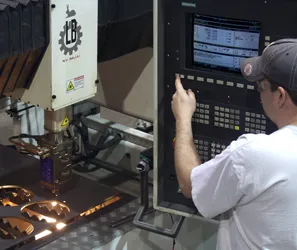
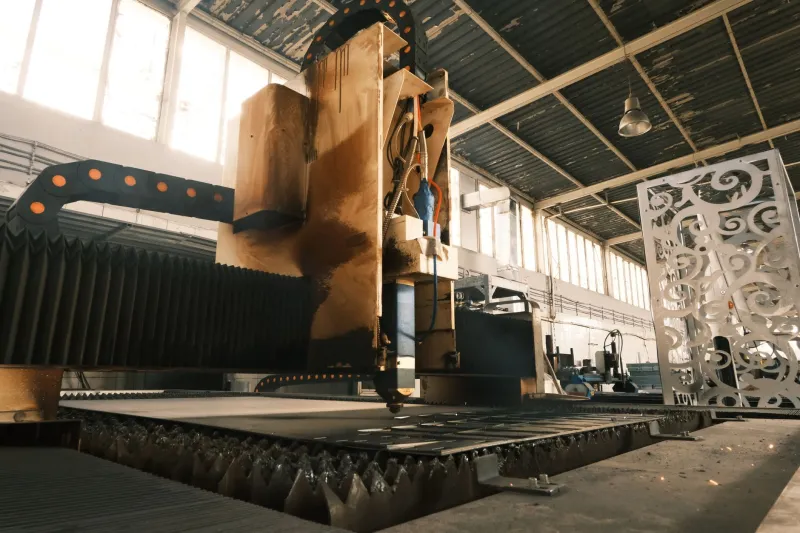
When Experience Becomes the Enemy of Accuracy: Rethinking How Veteran Operators Interact with Modern Laser Systems
Photo: Department of Defense. American Forces Information Service. Defense Visual Information Center. 1994, Public domain, via Wikimedia Commons
The Paradox Nobody Wants to Talk About
In most American manufacturing facilities, the senior laser operator is treated as an institutional resource. They know the quirks of every machine on the floor. They can hear a problem before it appears on a readout. They've kept production running through situations that would have stopped a less experienced technician cold. That expertise is real, earned, and genuinely valuable.
It is also, under certain conditions, a liability.
This is not a comfortable observation to make, and it is not one that dismisses the contributions of skilled operators. But when a technician's accumulated intuition begins to override the calibrated sensor data and diagnostic feedback built into modern laser systems, something goes wrong — quietly, gradually, and at measurable cost to the operation.
Understanding why this happens, and what to do about it, is one of the more pressing operational challenges facing US manufacturers today.
How Intuition Gets Built — and Why It Calcifies
Operator intuition is not arbitrary. It develops through thousands of hours of direct engagement with equipment: watching how a beam behaves under different material conditions, learning which parameter adjustments produce which results, recognizing the early signs of component fatigue before formal diagnostics flag anything. This is pattern recognition at a high level, and for years, it was the primary tool available.
The problem is that pattern recognition learned on older systems does not always transfer cleanly to newer ones. A technician who spent a decade operating a 2-kilowatt fiber laser has internalized a set of behavioral expectations that may not apply to a 6-kilowatt system with updated beam delivery architecture and a different thermal management profile. The surface experience looks identical. The underlying physics are not.
More critically, intuition built before the widespread adoption of real-time diagnostic monitoring was built in the absence of that data. Operators who learned to read a machine through feel, sound, and visual output never developed the habit of cross-referencing those impressions against sensor feedback — because the sensor feedback didn't exist in the same form. Now that it does, the habit still isn't there.
The Specific Decisions That Go Wrong
On US production floors, this dynamic tends to surface in a handful of recurring patterns.
The first involves parameter adjustment. Experienced operators frequently modify cutting speed, focal position, or assist gas pressure based on what a cut looks like rather than what the system's monitoring data indicates. In many cases, these adjustments are directionally correct. In a significant number, they are not — and because the operator is confident, the deviation from optimal settings persists longer than it would if a less experienced technician were involved. A newer operator would check the data. A veteran trusts the feel.
The second pattern involves maintenance deferrals. Senior technicians often develop an accurate sense of how much performance degradation a system can sustain before quality becomes visibly unacceptable. The key word is visibly. Modern laser systems accumulate wear that affects output consistency and component longevity well before any cut looks wrong to the human eye. An operator who has learned to defer maintenance until a problem is perceptible is, by definition, operating in a window where data-measurable damage is already occurring.
The third pattern is the most subtle: selective attention to diagnostic alerts. Operators who have seen a particular alert trigger without apparent consequence tend to dismiss subsequent instances of that alert. This is rational behavior based on prior experience. It is also how small anomalies compound into significant failures without anyone recognizing the progression.
The Data Is Not the Threat
There is a cultural dimension to this problem that deserves direct acknowledgment. In many American manufacturing environments, an operator who relies heavily on instrumentation is implicitly signaling that they don't fully trust their own judgment. The inverse — the technician who knows the machine well enough not to need the readouts — carries a certain professional prestige.
This culture was functional when diagnostic tools were limited and operator experience was the best available proxy for system state. It is increasingly dysfunctional in facilities running precision laser systems that generate continuous, high-resolution performance data. Ignoring that data is not a demonstration of expertise. It is a refusal to use a more accurate instrument.
The manufacturers who are navigating this most successfully are not the ones who have sidelined their experienced operators. They are the ones who have reframed the relationship between operator judgment and diagnostic data — positioning the data not as a challenge to expertise but as an extension of it.
Building a Hybrid Validation Model
The practical path forward is not to choose between experienced operators and data-driven systems. It is to build workflows that require both to agree before a significant parameter decision is finalized.
This looks different in different facilities, but several structural approaches have demonstrated consistent results.
First, establishing documented baseline parameters for each material and thickness combination — and requiring that any deviation from those baselines be logged with a stated rationale — creates a record that allows supervisors and operators alike to evaluate whether intuition-driven adjustments are producing measurable improvements or simply reflecting habit.
Second, involving senior operators in the interpretation of diagnostic data, rather than positioning that data as an automated override, tends to produce better buy-in. When an experienced technician is asked to explain what a particular sensor trend means given their knowledge of the machine, they often arrive at accurate conclusions. The problem is not that they lack the analytical capability. It is that nobody asked them to apply it in that direction.
Third, structured post-run reviews — comparing operator-reported observations against logged system data for the same production period — help close the gap between felt experience and measured reality. Over time, this calibrates operator intuition against actual system behavior rather than against remembered behavior from different machines in different conditions.
What This Means for Procurement and Training
For US manufacturing leaders evaluating laser systems or planning operator training programs, this dynamic has direct implications.
On the equipment side, systems with accessible, clearly presented diagnostic interfaces are not a luxury feature. They are a prerequisite for building the kind of data-operator integration described above. A system whose monitoring data is buried in menus or presented in formats that operators find difficult to interpret will not be used effectively, regardless of how sophisticated the underlying sensors are.
On the training side, the most valuable investment is not in teaching experienced operators how to use new equipment — they will figure that out. It is in teaching them how to treat diagnostic data as a peer input rather than a subordinate one. That is a professional reorientation, not a technical skill, and it requires deliberate attention.
Respecting Experience Without Being Captured by It
The goal of this analysis is not to diminish what experienced laser operators bring to a manufacturing operation. Their knowledge of material behavior, their ability to recognize developing problems, and their capacity to make sound decisions under production pressure are genuinely difficult to replace.
The goal is to identify the specific conditions under which that experience works against precision outcomes — and to argue that those conditions are becoming more common, not less, as laser systems grow more capable and more instrumented.
An operator who combines deep hands-on knowledge with disciplined engagement with diagnostic data is not a compromise between two approaches. They are the highest-value technician on your floor. Building the conditions that produce that kind of operator is one of the more consequential investments an American manufacturer can make right now.